
Grok 4.6 vs Grok 4.5: a cautious upgrade guide
August 13, 2026 · By Sharjeel Abbas
Grok 4.6 carries the same listed base token prices and 500K context size as Grok 4.5 on OpenRouter, but a new model ID can still change behavior. Upgrade by workload cohort, keep old assemblies reproducible, and promote only after the new version clears quality, latency, and cost gates.
The primary catalog sources for this analysis are OpenRouter's DeepSeek V4 Pro 0813 listing and OpenRouter's Grok 4.6 listing. Specifications and prices below were checked against OpenRouter's models API on August 13, 2026. Provider metadata can change, so production buyers should recheck the live listing before committing a fixed budget.
Related reading:
What the public metadata establishes
Both catalog entries are frontier xAI models listed at $2/M input and $6/M output with a 500,000-token context window. Grok 4.6 accepts text, image, and file input and lists reasoning, tools, response formats, and structured outputs. The provider description calls it the smartest SpaceXAI model and highlights coding, knowledge work, and STEM. Those facts justify evaluation, not automatic replacement.
The versioned IDs are the safety mechanism. An existing assembly that names x-ai/grok-4.5 should continue to name it. A new canary assembly can use x-ai/grok-4.6. Avoid changing a shared alias during evaluation because failures become impossible to attribute and old benchmark results no longer describe the runtime.
Run a reversible migration
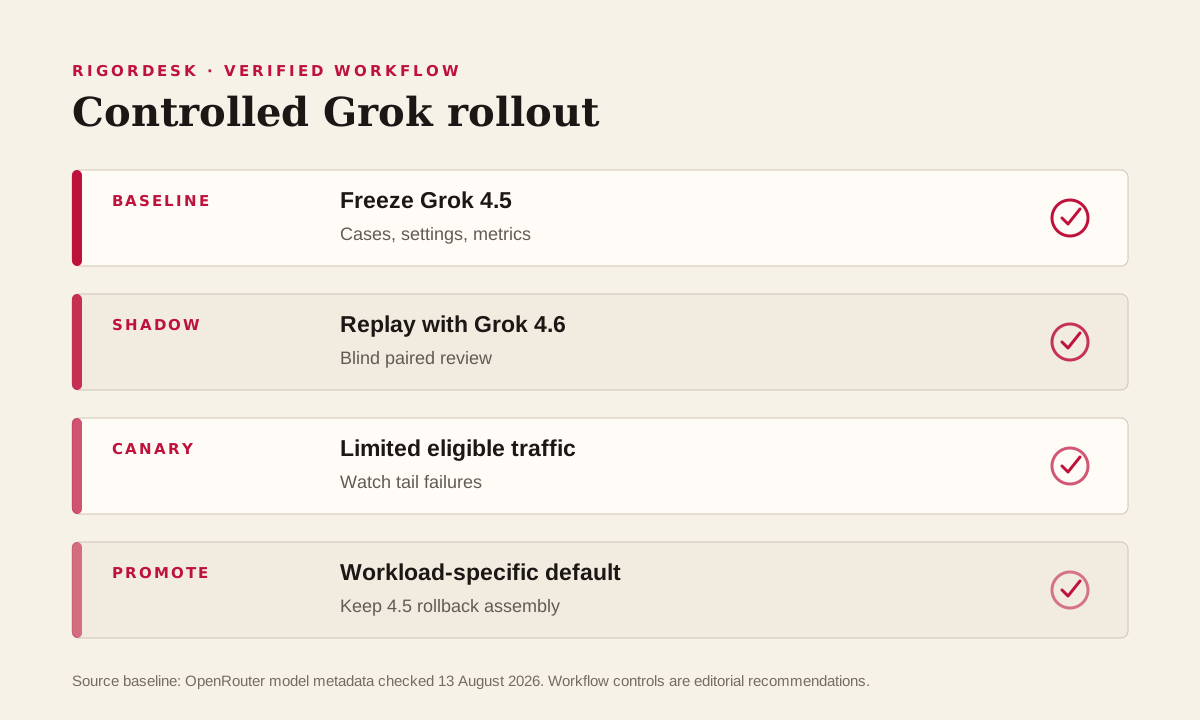
Build a case set from recent production prompts: ordinary, adversarial, long-context, multimodal, tool-using, and schema-constrained. Replay it with fixed parameters. Compare task success, supported-claim rate, tool errors, invalid structured outputs, latency percentiles, output tokens, and total cost. Read paired failures rather than averaging every task into one score.
Promote by use case. Grok 4.6 may become the default attacker before it becomes the default file reviewer, or vice versa. Keep Grok 4.5 available until the new model has survived live canaries and the provider's availability is stable. Define rollback triggers in advance: schema error rate, timeout rate, material cost regression, or a critical task failure.
Freeze the current Grok 4.5 baseline
Before testing 4.6, export the exact Grok 4.5 assembly configuration: model ID, system instructions, tools and schemas, reasoning setting, temperature, output cap, retrieval behavior, and debate format. Select recent cases that represent the real distribution rather than only polished demos. Record current success rates, latency percentiles, output tokens, retries, and known failure modes. Without this baseline, a team can notice that the new version feels different but cannot determine whether the change is beneficial.
Protect the evaluation set from accidental tuning. Separate a development set used to adjust prompts from a holdout set used for promotion. Include failures that were expensive or embarrassing, not just common requests. Add cases with unavailable tools, malformed evidence, missing information, and requests that should be refused or marked uncertain. An upgrade that improves average prose but regresses the cases that motivated the review workflow should not become the default.
Compare behavior, not only final preference
Inspect intermediate behavior: which evidence was cited, which tools were selected, whether arguments matched schemas, how the model responded to tool errors, and whether dissent survived synthesis. For structured outputs, validate every response and classify failures rather than repairing them silently. For multimodal tasks, verify observations against the original artifact. Human preference can capture clarity and usefulness, but executable and evidence-based checks should decide correctness wherever possible.
Use paired review so each case yields a 4.5 and 4.6 result under the same conditions. Blind model names when reviewers could be influenced by launch expectations. Report wins, ties, regressions, and unscorable cases by workload. A large improvement in coding does not erase a regression in file review if both workloads matter. Promotion can be segmented: 4.6 may become the default critic while 4.5 remains the stable choice for another seat until further evidence accumulates.
Operate the canary and rollback
Route a limited share of eligible production cases to a versioned 4.6 assembly and monitor the same metrics used in offline evaluation. Keep user-visible outputs traceable to the model ID. Review every critical failure and a random sample of apparently successful runs. Watch provider errors and tail latency in addition to model quality, because an upgrade that is accurate in a test environment can still be operationally unsuitable during peak traffic.
Rollback should be a configuration change, not an emergency code deployment. Define triggers before the canary: a critical unsupported claim, a schema-error threshold, repeated tool misuse, a latency breach, or a material cost increase. Preserve the 4.6 transcripts after rollback so the failure can be analyzed. Promote only after the canary window covers representative traffic and no unresolved blocker remains. Model launches reward speed, but audit-ready systems reward reversibility and evidence. Record who approved the promotion, which evaluation snapshot supported it, and when the next review is due so the default remains an accountable decision rather than an inherited assumption.
Decision table
| Migration stage | Gate | Fallback |
|---|---|---|
| Frozen baseline | 4.5 metrics and cases captured | Continue existing assembly |
| Shadow evaluation | 4.6 clears workload-specific thresholds | Revise or reject candidate |
| Production canary | Tail quality and operations remain stable | Route traffic back to 4.5 |
| Default promotion | Representative window has no blocker | Retain versioned rollback assembly |
Visual summary
Verified specification baseline
| Field | DeepSeek V4 Pro 0813 | Grok 4.6 |
|---|---|---|
| OpenRouter model ID | deepseek/deepseek-v4-pro-0813 | x-ai/grok-4.6 |
| Release status | GA release of DeepSeek V4 Pro | Current SpaceXAI frontier listing |
| Context window | 1,048,576 tokens | 500,000 tokens |
| Input modalities | Text | Text, image, file |
| Output modality | Text | Text |
| Standard input price | $0.435 per million tokens | $2 per million tokens |
| Standard output price | $0.87 per million tokens | $6 per million tokens |
| Long-prompt override | None listed | Above 200,000 prompt tokens: $4/M input and $12/M output |
| Reasoning controls | Supported | Supported |
| Tool calling | Supported | Supported |
The table is a capability and cost baseline, not a quality ranking. A larger context window does not prove better retrieval from the middle of a long prompt. A lower token price does not prove lower total task cost because output length, retries, reasoning tokens, and tool calls all affect the bill. A multimodal input declaration confirms accepted media types, not accuracy on every chart, screenshot, scan, or document.
Neither listing supplied a new, independently replicated benchmark suite at publication time. That absence matters. It is reasonable to describe Grok 4.6 as intended for coding, knowledge work, and STEM because the provider says so; it is not reasonable to turn that sentence into an unqualified claim that Grok wins a particular coding or science benchmark. The same rule applies to the DeepSeek GA label: general availability describes release maturity, not guaranteed superiority over the earlier model on every workload.
How to evaluate the models on RigorDesk
Start with a controlled case set drawn from real work. Keep the source packet, prompt, output contract, reasoning setting, web-search setting, and maximum output length fixed. Randomize seat order or use a silent Delphi first round so the first model does not anchor the rest. Record model IDs rather than family names because deepseek/deepseek-v4-pro and deepseek/deepseek-v4-pro-0813 are different runtime contracts.
Score outcomes that users can inspect: factual claims supported by the attached evidence, important objections found, invalid objections avoided, instructions followed, useful citations produced, schema validity, completion latency, and metered cost. For coding work, add tests passed and regressions introduced. For document review, add page-level evidence recall and whether the model distinguishes missing evidence from negative evidence. For a debate, preserve dissent instead of rewarding superficial agreement.
Run enough cases to expose variance. A single polished response is a demonstration, not an evaluation. Compare medians and failure distributions, then read the worst failures. Expensive mistakes are often concentrated in a small class of prompts: very long inputs, malformed files, ambiguous requirements, or tasks that require several tools. Those tail cases should influence the final seat assignment more than a small difference in average style scores.
Deployment checklist
- Use separate versioned assemblies during the canary period.
- Replay real prompts with fixed settings and evidence.
- Promote per workload rather than all at once.
- Keep explicit rollback thresholds and the Grok 4.5 path.
On RigorDesk, both models are in the paid catalog and can be selected in assemblies, debates, Draft, and Review. Paid plans share access to the complete model catalog; Pro Max changes compute allowance and round depth. Prepaid credits also unlock paid models in the web app. The editor estimates a run before launch, while the audit trail records actual token use and provider cost after completion.
Model availability is only one layer of a reliable workflow. Keep evidence attached, define role boundaries, require explicit uncertainty, and assign a separate chairman or synthesizer when the decision is consequential. The goal is not to prove that one vendor always wins. The goal is to discover which model contributes the most independent, verifiable value for a specific class of decisions.