
How to evaluate Grok 4.6 for coding, knowledge work, and STEM
August 13, 2026 · By Sharjeel Abbas
OpenRouter describes Grok 4.6 as a frontier model for coding, knowledge work, and STEM. That is a useful evaluation agenda, not a completed evaluation. Each category needs different evidence, scoring, tools, and failure thresholds.
The primary catalog sources for this analysis are OpenRouter's DeepSeek V4 Pro 0813 listing and OpenRouter's Grok 4.6 listing. Specifications and prices below were checked against OpenRouter's models API on August 13, 2026. Provider metadata can change, so production buyers should recheck the live listing before committing a fixed budget.
Related reading:
Three workloads, three scorecards
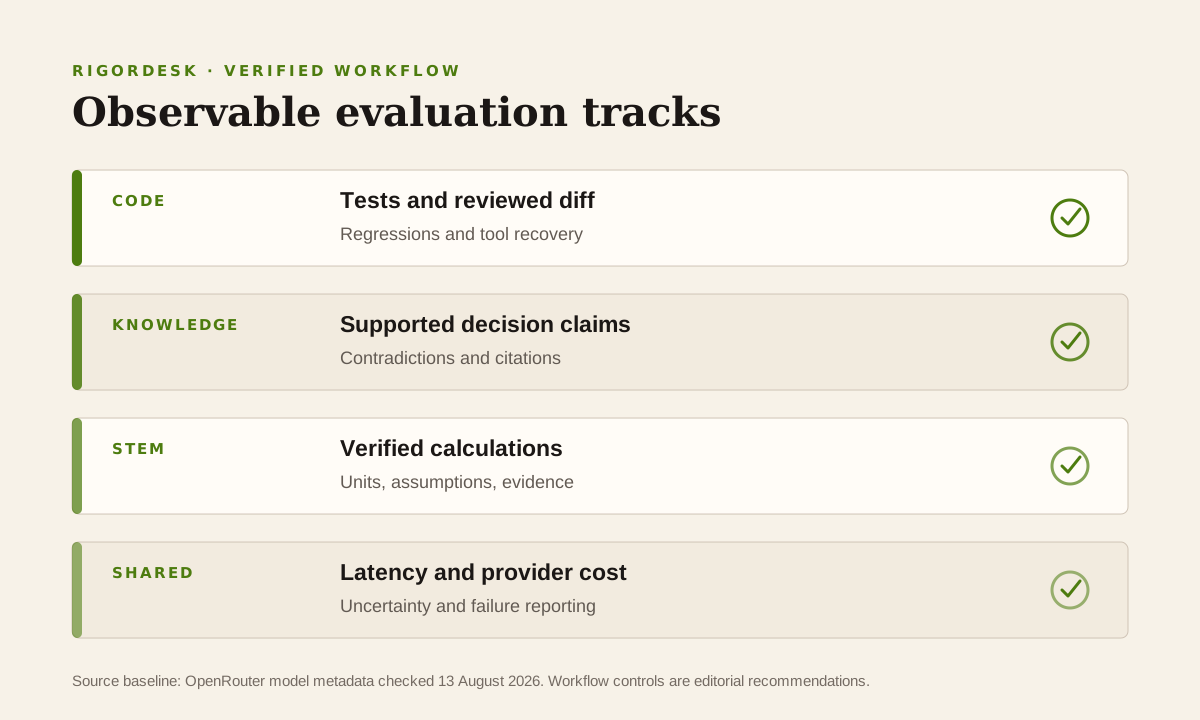
Coding should be scored on repository-grounded tasks with executable tests, linting, type checks, regression review, and diff quality. Knowledge work should be scored on supported claims, document coverage, decision usefulness, and explicit uncertainty. STEM should separate symbolic reasoning, numerical calculation, domain knowledge, and evidence retrieval. A single preference score hides these distinctions.
Grok's image and file inputs enable realistic cases: debug from a screenshot plus logs, review a spreadsheet export plus memo, or analyze a diagram alongside requirements. Keep the expected output observable. A coding answer is not correct because it sounds architectural; the patch and tests decide. A research memo is not correct because it is confident; cited evidence and contradiction handling decide.
Use adversarial peer review
Pair Grok with a different lab and assign explicit roles. Grok can author while DeepSeek attacks unsupported text claims, then reverse the roles on another case. Use silent first responses to reduce anchoring. Ask the chairman to retain failure evidence and minority views rather than compressing the panel into an agreeable narrative.
Track tool behavior separately from final-answer quality. A model can reason well but call the wrong tool, pass malformed arguments, or ignore a failed result. Structured-output validation, tool error rate, retry count, and recovery behavior belong in the scorecard. Because no trustworthy Grok 4.6 benchmark table was available at launch, this production-style evaluation is the evidence that should drive seat selection.
Design the coding track
Select repository-grounded tasks that reflect actual maintenance: fix a regression, add a bounded feature, explain a failure, review a risky diff, and work across several files without touching unrelated code. Provide the same repository state, instructions, tools, and time budget to each candidate. The primary result is whether the required tests, type checks, and lint rules pass. Secondary review should inspect unnecessary changes, security mistakes, architecture fit, and whether the model preserved existing behavior outside the requested scope.
Separate planning from execution. A persuasive plan can hide a patch that does not compile, while a terse plan may lead to a correct change. Record tool calls, failed commands, retries, and whether the model recovered from real feedback. Include tasks with ambiguous requirements to test clarification and tasks with failing infrastructure to test diagnosis. Score fabricated success claims as failures even when the prose is confident. The observable repository state, not the model's self-report, decides the outcome.
Design the knowledge-work track
Use memos, contracts, policies, financial materials, and research packets with known contradictions. Ask for a decision artifact whose claims link to specific sources. Score important evidence found, unsupported claims, contradiction handling, missing-information disclosure, and whether recommendations follow from the evidence. Grok's native file and image support should be tested with original documents, while a text-only condition reveals how much performance comes from modality rather than reasoning.
Include adversarial sources that use similar language but different dates, definitions, or denominators. Require the model to distinguish primary evidence from commentary and current terms from superseded versions. Human reviewers should verify material citations rather than grade the memo by fluency. Measure whether the output changes the decision, identifies a new risk, or correctly preserves uncertainty. A useful knowledge-work model makes the reasoning easier to audit; it does not merely make the answer sound more senior.
Design the STEM track
Split STEM into symbolic reasoning, numerical calculation, scientific knowledge, diagram interpretation, and evidence retrieval. Use unit-checked problems, executable calculations, and domain-reviewed answer keys. Ask for assumptions and intermediate quantities that can be inspected without demanding hidden chain-of-thought. For questions involving current literature or external facts, provide a controlled source set or enable a documented search path, then verify citations. Do not mix closed-book mathematics with open-web research in one undifferentiated score.
Add perturbation tests that change a unit, boundary condition, diagram label, or numerical input while preserving the surface structure. A model that repeats a memorized pattern will fail when the decisive detail changes. Track calibration by comparing expressed uncertainty with actual correctness. Review the worst errors for potential harm, not just aggregate accuracy. The appropriate Grok seat depends on which failure modes remain after this decomposition and whether a second model reliably catches them during adversarial review. Retain failed cases in the suite, because removing uncomfortable examples turns an evaluation into marketing and prevents later versions from proving that the weakness was actually corrected.
Decision table
| Evaluation track | Primary observable | Material failure |
|---|---|---|
| Coding | Tests, checks, and reviewed diff | Regression or fabricated completion |
| Knowledge work | Supported claims and decision usefulness | Missed contradiction or false citation |
| STEM | Verified calculation or domain answer | Wrong assumption, unit, or evidence |
| All tracks | Tool reliability, latency, and cost | Unsafe action or unreported failure |
Visual summary
Verified specification baseline
| Field | DeepSeek V4 Pro 0813 | Grok 4.6 |
|---|---|---|
| OpenRouter model ID | deepseek/deepseek-v4-pro-0813 | x-ai/grok-4.6 |
| Release status | GA release of DeepSeek V4 Pro | Current SpaceXAI frontier listing |
| Context window | 1,048,576 tokens | 500,000 tokens |
| Input modalities | Text | Text, image, file |
| Output modality | Text | Text |
| Standard input price | $0.435 per million tokens | $2 per million tokens |
| Standard output price | $0.87 per million tokens | $6 per million tokens |
| Long-prompt override | None listed | Above 200,000 prompt tokens: $4/M input and $12/M output |
| Reasoning controls | Supported | Supported |
| Tool calling | Supported | Supported |
The table is a capability and cost baseline, not a quality ranking. A larger context window does not prove better retrieval from the middle of a long prompt. A lower token price does not prove lower total task cost because output length, retries, reasoning tokens, and tool calls all affect the bill. A multimodal input declaration confirms accepted media types, not accuracy on every chart, screenshot, scan, or document.
Neither listing supplied a new, independently replicated benchmark suite at publication time. That absence matters. It is reasonable to describe Grok 4.6 as intended for coding, knowledge work, and STEM because the provider says so; it is not reasonable to turn that sentence into an unqualified claim that Grok wins a particular coding or science benchmark. The same rule applies to the DeepSeek GA label: general availability describes release maturity, not guaranteed superiority over the earlier model on every workload.
How to evaluate the models on RigorDesk
Start with a controlled case set drawn from real work. Keep the source packet, prompt, output contract, reasoning setting, web-search setting, and maximum output length fixed. Randomize seat order or use a silent Delphi first round so the first model does not anchor the rest. Record model IDs rather than family names because deepseek/deepseek-v4-pro and deepseek/deepseek-v4-pro-0813 are different runtime contracts.
Score outcomes that users can inspect: factual claims supported by the attached evidence, important objections found, invalid objections avoided, instructions followed, useful citations produced, schema validity, completion latency, and metered cost. For coding work, add tests passed and regressions introduced. For document review, add page-level evidence recall and whether the model distinguishes missing evidence from negative evidence. For a debate, preserve dissent instead of rewarding superficial agreement.
Run enough cases to expose variance. A single polished response is a demonstration, not an evaluation. Compare medians and failure distributions, then read the worst failures. Expensive mistakes are often concentrated in a small class of prompts: very long inputs, malformed files, ambiguous requirements, or tasks that require several tools. Those tail cases should influence the final seat assignment more than a small difference in average style scores.
Deployment checklist
- Use executable tests for coding claims.
- Require citations and contradiction handling for knowledge work.
- Separate calculation, reasoning, and retrieval in STEM cases.
- Score tool failures and recovery independently.
On RigorDesk, both models are in the paid catalog and can be selected in assemblies, debates, Draft, and Review. Paid plans share access to the complete model catalog; Pro Max changes compute allowance and round depth. Prepaid credits also unlock paid models in the web app. The editor estimates a run before launch, while the audit trail records actual token use and provider cost after completion.
Model availability is only one layer of a reliable workflow. Keep evidence attached, define role boundaries, require explicit uncertainty, and assign a separate chairman or synthesizer when the decision is consequential. The goal is not to prove that one vendor always wins. The goal is to discover which model contributes the most independent, verifiable value for a specific class of decisions.