
Grok 4.6 for multimodal file and evidence review
August 13, 2026 · By Sharjeel Abbas
Grok 4.6's most concrete distinction from DeepSeek V4 Pro 0813 is native evidence breadth. It can accept text, images, and files. That makes it valuable for charts, screenshots, diagrams, and mixed document packs, provided the workflow demands traceable evidence rather than trusting a fluent visual summary.
The primary catalog sources for this analysis are OpenRouter's DeepSeek V4 Pro 0813 listing and OpenRouter's Grok 4.6 listing. Specifications and prices below were checked against OpenRouter's models API on August 13, 2026. Provider metadata can change, so production buyers should recheck the live listing before committing a fixed budget.
Related reading:
What native file input changes
Native input lets the reviewer see layout, color, grouping, annotations, and other signals that plain OCR may discard. A financial chart's legend, a UI screenshot's disabled state, or an architecture diagram's arrow direction can be decisive. The model can inspect the original artifact while another panel seat reads extracted text, creating a useful disagreement channel when conversion and interpretation diverge.
File support does not make every format equally reliable. Password-protected documents, corrupted uploads, huge scans, tiny labels, and uncommon encodings can still fail. The application should expose extraction status and page boundaries. A reviewer should be able to distinguish 'the evidence contradicts the claim' from 'the model could not read the evidence.'
A two-seat evidence protocol
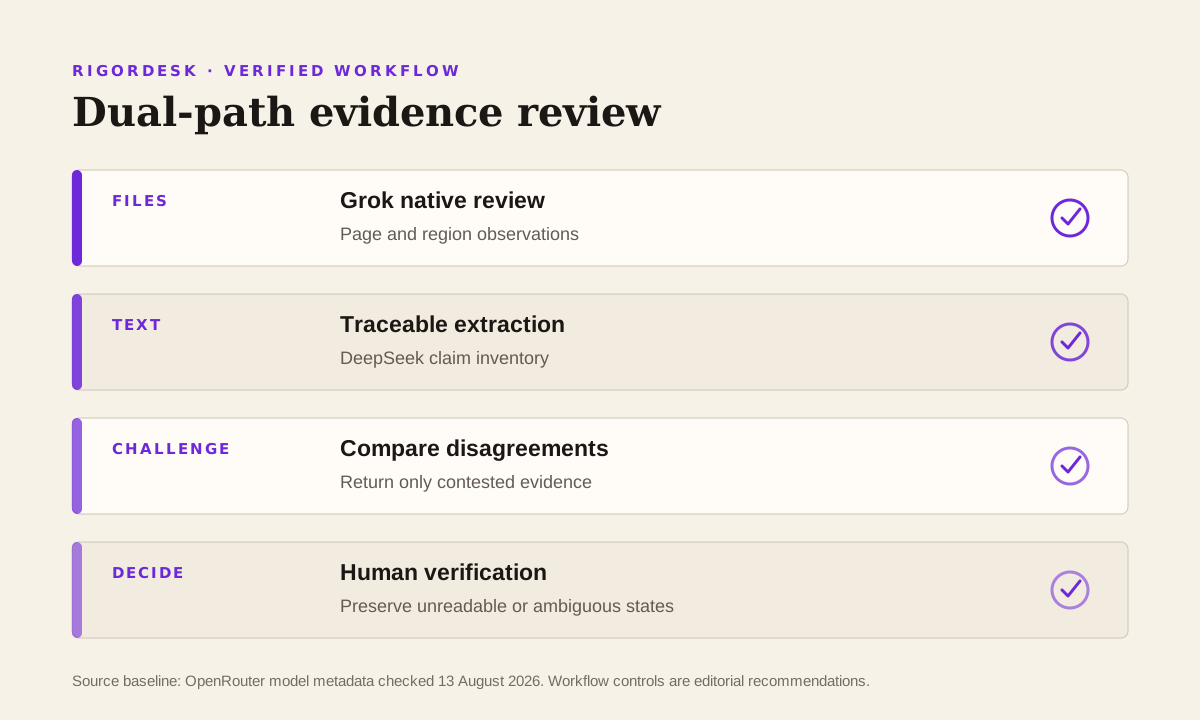
Seat Grok as the native-artifact reviewer and DeepSeek as the text-evidence reviewer. Ask each to produce claim, evidence location, interpretation, confidence, and missing-information fields. Then run a challenger round focused only on disagreements. If Grok cites a visual detail absent from extracted text, a human can inspect the page. If DeepSeek finds a clause Grok overlooks, the chairman keeps it unresolved until verified.
This protocol is stronger than asking one multimodal model for a final answer because it exposes the boundary between perception and reasoning. It is also more economical than sending every image to every model. Route only relevant artifacts, resize without destroying labels, and keep originals available for audit. For very long files, remember that Grok's listed price doubles above 200K prompt tokens.
Prepare files without erasing provenance
Assign each upload an immutable evidence ID and retain the original checksum, file name, media type, page count, and extraction status. Generate thumbnails or resized images only as derivatives and keep a link to the source. When a document has embedded charts, identify the page and figure number. When the evidence is a screenshot, record the capture context and timestamp if they matter. These details prevent a later reviewer from treating a convenient derivative as the authoritative artifact.
Run basic quality checks before inference. Detect password protection, corrupted files, blank pages, extreme dimensions, tiny text, unsupported encodings, and scans with poor contrast. The correct outcome for an unreadable page is an explicit limitation, not a guessed summary. Provide Grok with a concise manifest and require it to report which files and pages it could inspect. This makes missing evidence visible before the chairman converts the review into a decisive narrative.
Ask questions that separate perception from inference
Use a two-stage response. First ask for observable elements: labels, values, states, arrows, colors, annotations, and layout relationships with page or region references. Then ask what those observations imply for the claim under review. Separating the stages reduces the chance that a plausible interpretation is presented as a directly visible fact. It also gives a human reviewer a compact list of observations to verify against the artifact before accepting the broader conclusion.
Require uncertainty categories that distinguish unreadable, absent, ambiguous, and contradictory evidence. A tiny label may be unreadable even though the page is present. A required diagram may be absent from the packet. Two charts may use different denominators and appear contradictory. Those cases demand different follow-up actions. A single confidence score compresses the reason for uncertainty and can encourage false precision, while categorical evidence states route the problem to the correct remediation.
Red-team the visual review
Give a second seat the extracted text, captions, and Grok's claims, but not Grok's unsupported conclusions. Ask it to identify claims that lack textual support, numbers that conflict across sources, and assumptions introduced by layout interpretation. Then return only the contested points to Grok with the relevant original pages. This focused round is cheaper than repeating the entire packet and creates a documented dispute that a human can resolve quickly.
Evaluate the workflow with deliberately difficult artifacts: truncated screenshots, charts with dual axes, tables split across pages, low-resolution scans, diagrams whose arrows cross, and documents containing prompt-like text. Track observation accuracy, citation accuracy, abstention quality, and susceptibility to instructions embedded inside evidence. Treat files as untrusted content. The model may analyze them, but embedded text must not expand tool permissions, change system instructions, or trigger external actions.
Decision table
| Evidence condition | Required model response | Operator action |
|---|---|---|
| Readable and directly supportive | Observation, location, and bounded inference | Verify material claims |
| Present but unreadable | Name the page and limitation | Replace or enhance the source |
| Ambiguous visual encoding | List competing interpretations | Inspect legend and underlying data |
| Conflict with extracted text | Preserve the disagreement | Review the original artifact |
Visual summary
Verified specification baseline
| Field | DeepSeek V4 Pro 0813 | Grok 4.6 |
|---|---|---|
| OpenRouter model ID | deepseek/deepseek-v4-pro-0813 | x-ai/grok-4.6 |
| Release status | GA release of DeepSeek V4 Pro | Current SpaceXAI frontier listing |
| Context window | 1,048,576 tokens | 500,000 tokens |
| Input modalities | Text | Text, image, file |
| Output modality | Text | Text |
| Standard input price | $0.435 per million tokens | $2 per million tokens |
| Standard output price | $0.87 per million tokens | $6 per million tokens |
| Long-prompt override | None listed | Above 200,000 prompt tokens: $4/M input and $12/M output |
| Reasoning controls | Supported | Supported |
| Tool calling | Supported | Supported |
The table is a capability and cost baseline, not a quality ranking. A larger context window does not prove better retrieval from the middle of a long prompt. A lower token price does not prove lower total task cost because output length, retries, reasoning tokens, and tool calls all affect the bill. A multimodal input declaration confirms accepted media types, not accuracy on every chart, screenshot, scan, or document.
Neither listing supplied a new, independently replicated benchmark suite at publication time. That absence matters. It is reasonable to describe Grok 4.6 as intended for coding, knowledge work, and STEM because the provider says so; it is not reasonable to turn that sentence into an unqualified claim that Grok wins a particular coding or science benchmark. The same rule applies to the DeepSeek GA label: general availability describes release maturity, not guaranteed superiority over the earlier model on every workload.
How to evaluate the models on RigorDesk
Start with a controlled case set drawn from real work. Keep the source packet, prompt, output contract, reasoning setting, web-search setting, and maximum output length fixed. Randomize seat order or use a silent Delphi first round so the first model does not anchor the rest. Record model IDs rather than family names because deepseek/deepseek-v4-pro and deepseek/deepseek-v4-pro-0813 are different runtime contracts.
Score outcomes that users can inspect: factual claims supported by the attached evidence, important objections found, invalid objections avoided, instructions followed, useful citations produced, schema validity, completion latency, and metered cost. For coding work, add tests passed and regressions introduced. For document review, add page-level evidence recall and whether the model distinguishes missing evidence from negative evidence. For a debate, preserve dissent instead of rewarding superficial agreement.
Run enough cases to expose variance. A single polished response is a demonstration, not an evaluation. Compare medians and failure distributions, then read the worst failures. Expensive mistakes are often concentrated in a small class of prompts: very long inputs, malformed files, ambiguous requirements, or tasks that require several tools. Those tail cases should influence the final seat assignment more than a small difference in average style scores.
Deployment checklist
- Keep original files and extracted text linked by page identifier.
- Require every visual claim to name the artifact and region or page.
- Treat unreadable evidence as unresolved rather than false.
- Use a text-only second seat to expose extraction disagreements.
On RigorDesk, both models are in the paid catalog and can be selected in assemblies, debates, Draft, and Review. Paid plans share access to the complete model catalog; Pro Max changes compute allowance and round depth. Prepaid credits also unlock paid models in the web app. The editor estimates a run before launch, while the audit trail records actual token use and provider cost after completion.
Model availability is only one layer of a reliable workflow. Keep evidence attached, define role boundaries, require explicit uncertainty, and assign a separate chairman or synthesizer when the decision is consequential. The goal is not to prove that one vendor always wins. The goal is to discover which model contributes the most independent, verifiable value for a specific class of decisions.