
How to use DeepSeek V4 Pro 0813's million-token context
August 13, 2026 · By Sharjeel Abbas
A one-million-token window expands what can be reviewed in one call, but stuffing the window is not a retrieval strategy. DeepSeek V4 Pro 0813 is most useful when teams preserve document structure, identify evidence boundaries, and test whether decisive details survive at realistic depths.
The primary catalog sources for this analysis are OpenRouter's DeepSeek V4 Pro 0813 listing and OpenRouter's Grok 4.6 listing. Specifications and prices below were checked against OpenRouter's models API on August 13, 2026. Provider metadata can change, so production buyers should recheck the live listing before committing a fixed budget.
Related reading:
Good long-context workloads
Strong candidates include a repository with an architecture brief, a contract set with amendments, a research dossier with conflicting sources, or a long debate transcript that needs synthesis without lossy compression. Text-only input is the limiting condition. Images, scans, and diagrams should be extracted with provenance so the model can cite the correct page and reviewers can inspect conversion errors.
The window also helps comparative review. A model can see the proposal, counterproposal, evidence, and prior objections together. That reduces the need to summarize away minority views. It does not eliminate attention dilution. Teams should place a table of contents, stable document labels, and explicit questions in the prompt, then require citations back to those labels.
Test the middle, not only the limit
Create retrieval probes with facts near the beginning, middle, and end of the corpus. Include similar but incorrect distractors. Ask for quoted evidence and location identifiers, then score exact support. Repeat with several corpus sizes. This reveals whether the task benefits from full-context submission or needs retrieval that narrows the evidence before generation.
Long context can increase both latency and downstream transcript size. In a multi-round debate, every participant does not need every appendix on every turn. RigorDesk's document retrieval should deliver relevant passages while the original files remain attached for audit. Use the million-token capacity as headroom for hard cases, not a target to fill routinely.
Design the evidence packet
Give every source a stable identifier, human-readable title, date, and boundary marker. Preserve page numbers or line ranges during extraction and place a compact manifest before the documents. The prompt should state which sources are authoritative, which are commentary, and what to do when they conflict. A model cannot reliably cite an archive whose documents blur together. Stable labels also let a second reviewer inspect the exact passage behind a claim instead of searching a million-token transcript for similar wording.
Normalize text without destroying meaning. Keep headings, table rows, footnotes, code fences, and amendment relationships. Record where OCR was used and attach confidence or warning information when extraction is uncertain. Images and diagrams require a separate path because DeepSeek's listing is text-only. A caption generated upstream should be labeled as a derived interpretation, not presented as if it were the original artifact. The evidence manifest should link that derivative back to the page and file from which it came.
Build a long-context evaluation harness
Plant answerable questions at controlled depths and include near-duplicate distractors that differ in a decisive number, date, exception, or party. Ask the model to return the source ID, location, short supporting passage, and conclusion. Score whether the cited evidence actually entails the answer. Repeat the suite at increasing corpus sizes and randomize the placement of target facts. This test catches lost-in-the-middle behavior, false matching, and unsupported synthesis that a simple 'did it answer?' check will miss.
Add abstention cases where the evidence packet does not contain the answer. A long-context system that always returns a confident result may be matching familiar language rather than retrieving support. Measure false citations and fabricated locations separately from omissions. Run the same harness with retrieval-based narrowing and compare accuracy, latency, and cost. Full-context submission wins only when it produces enough additional supported findings to justify the extra processing and larger failure surface.
Use hierarchical review for production
A robust workflow divides the corpus into logical units, produces traceable claim inventories, and then synthesizes only the claims and evidence relevant to the decision. DeepSeek can serve as the broad text analyst because its context and price permit substantial coverage. A challenger can receive the most consequential claims plus their supporting passages rather than the entire archive. The final chair receives the claim map, objections, citations, and unresolved gaps. Each reduction step retains a pointer back to the original source.
Escalate to the full million-token window when cross-document relationships make narrower retrieval unreliable, such as contracts with amendments, a repository plus design history, or a dossier whose contradictions span many sources. Even then, keep explicit sections and ask focused questions. The window is valuable headroom for difficult cases, but production discipline still comes from evidence architecture, retrieval tests, and a review trail that lets humans trace a conclusion without rereading the complete input.
Decision table
| Long-context risk | Control | Pass condition |
|---|---|---|
| Lost evidence in the middle | Position-randomized retrieval probes | Supported answer at each tested depth |
| Near-duplicate confusion | Contradictory distractors | Correct source and decisive detail |
| Fabricated support | Unanswerable cases and citation checks | Explicit abstention without false locations |
| Unbounded cost and latency | Corpus-size ladder and retrieval baseline | Measured benefit justifies full context |
Visual summary
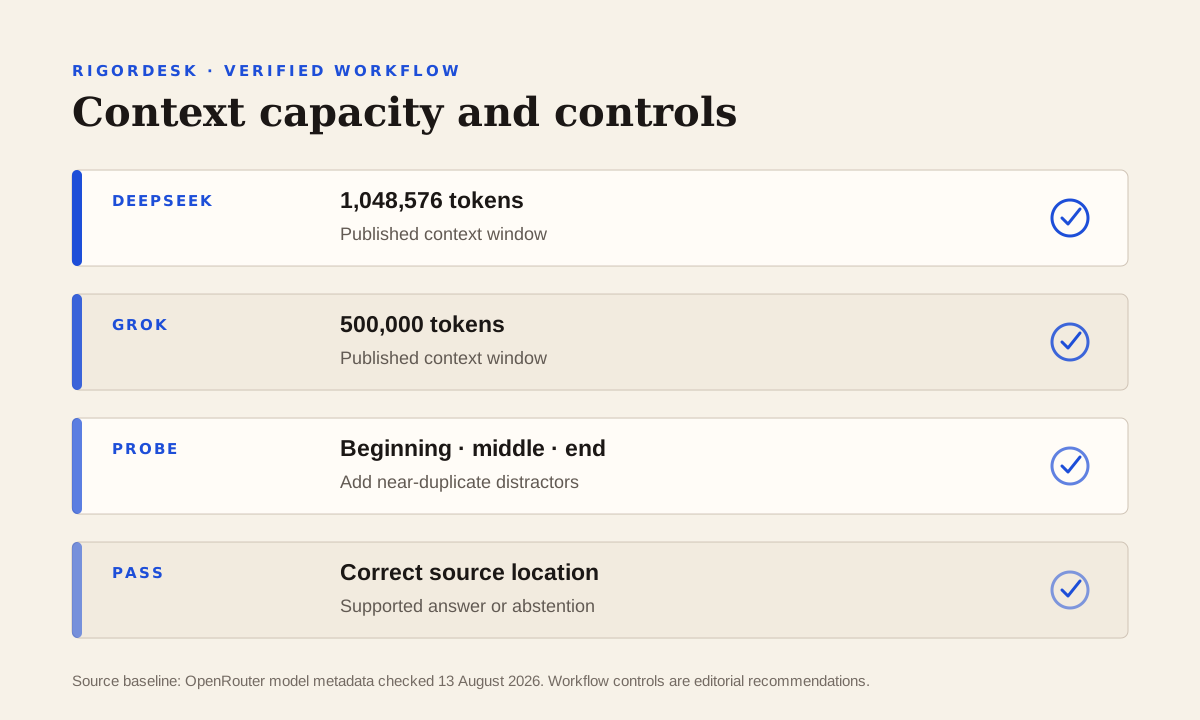
Verified specification baseline
| Field | DeepSeek V4 Pro 0813 | Grok 4.6 |
|---|---|---|
| OpenRouter model ID | deepseek/deepseek-v4-pro-0813 | x-ai/grok-4.6 |
| Release status | GA release of DeepSeek V4 Pro | Current SpaceXAI frontier listing |
| Context window | 1,048,576 tokens | 500,000 tokens |
| Input modalities | Text | Text, image, file |
| Output modality | Text | Text |
| Standard input price | $0.435 per million tokens | $2 per million tokens |
| Standard output price | $0.87 per million tokens | $6 per million tokens |
| Long-prompt override | None listed | Above 200,000 prompt tokens: $4/M input and $12/M output |
| Reasoning controls | Supported | Supported |
| Tool calling | Supported | Supported |
The table is a capability and cost baseline, not a quality ranking. A larger context window does not prove better retrieval from the middle of a long prompt. A lower token price does not prove lower total task cost because output length, retries, reasoning tokens, and tool calls all affect the bill. A multimodal input declaration confirms accepted media types, not accuracy on every chart, screenshot, scan, or document.
Neither listing supplied a new, independently replicated benchmark suite at publication time. That absence matters. It is reasonable to describe Grok 4.6 as intended for coding, knowledge work, and STEM because the provider says so; it is not reasonable to turn that sentence into an unqualified claim that Grok wins a particular coding or science benchmark. The same rule applies to the DeepSeek GA label: general availability describes release maturity, not guaranteed superiority over the earlier model on every workload.
How to evaluate the models on RigorDesk
Start with a controlled case set drawn from real work. Keep the source packet, prompt, output contract, reasoning setting, web-search setting, and maximum output length fixed. Randomize seat order or use a silent Delphi first round so the first model does not anchor the rest. Record model IDs rather than family names because deepseek/deepseek-v4-pro and deepseek/deepseek-v4-pro-0813 are different runtime contracts.
Score outcomes that users can inspect: factual claims supported by the attached evidence, important objections found, invalid objections avoided, instructions followed, useful citations produced, schema validity, completion latency, and metered cost. For coding work, add tests passed and regressions introduced. For document review, add page-level evidence recall and whether the model distinguishes missing evidence from negative evidence. For a debate, preserve dissent instead of rewarding superficial agreement.
Run enough cases to expose variance. A single polished response is a demonstration, not an evaluation. Compare medians and failure distributions, then read the worst failures. Expensive mistakes are often concentrated in a small class of prompts: very long inputs, malformed files, ambiguous requirements, or tasks that require several tools. Those tail cases should influence the final seat assignment more than a small difference in average style scores.
Deployment checklist
- Preserve source labels and page references during text extraction.
- Probe retrieval at several positions and corpus sizes.
- Keep distractors in evaluation cases to measure false retrieval.
- Use selective evidence delivery for later debate rounds.
On RigorDesk, both models are in the paid catalog and can be selected in assemblies, debates, Draft, and Review. Paid plans share access to the complete model catalog; Pro Max changes compute allowance and round depth. Prepaid credits also unlock paid models in the web app. The editor estimates a run before launch, while the audit trail records actual token use and provider cost after completion.
Model availability is only one layer of a reliable workflow. Keep evidence attached, define role boundaries, require explicit uncertainty, and assign a separate chairman or synthesizer when the decision is consequential. The goal is not to prove that one vendor always wins. The goal is to discover which model contributes the most independent, verifiable value for a specific class of decisions.