
DeepSeek V4 Pro 0813 and Grok 4.6 pricing explained
August 13, 2026 · By Sharjeel Abbas
Headline token rates make DeepSeek look dramatically cheaper, but a responsible estimate also includes output length, reasoning, repeated context, tools, retries, panel size, and Grok's long-prompt override. This guide turns the public rates into concrete review budgets without pretending the estimate is the final invoice.
The primary catalog sources for this analysis are OpenRouter's DeepSeek V4 Pro 0813 listing and OpenRouter's Grok 4.6 listing. Specifications and prices below were checked against OpenRouter's models API on August 13, 2026. Provider metadata can change, so production buyers should recheck the live listing before committing a fixed budget.
Related reading:
Worked base-rate examples
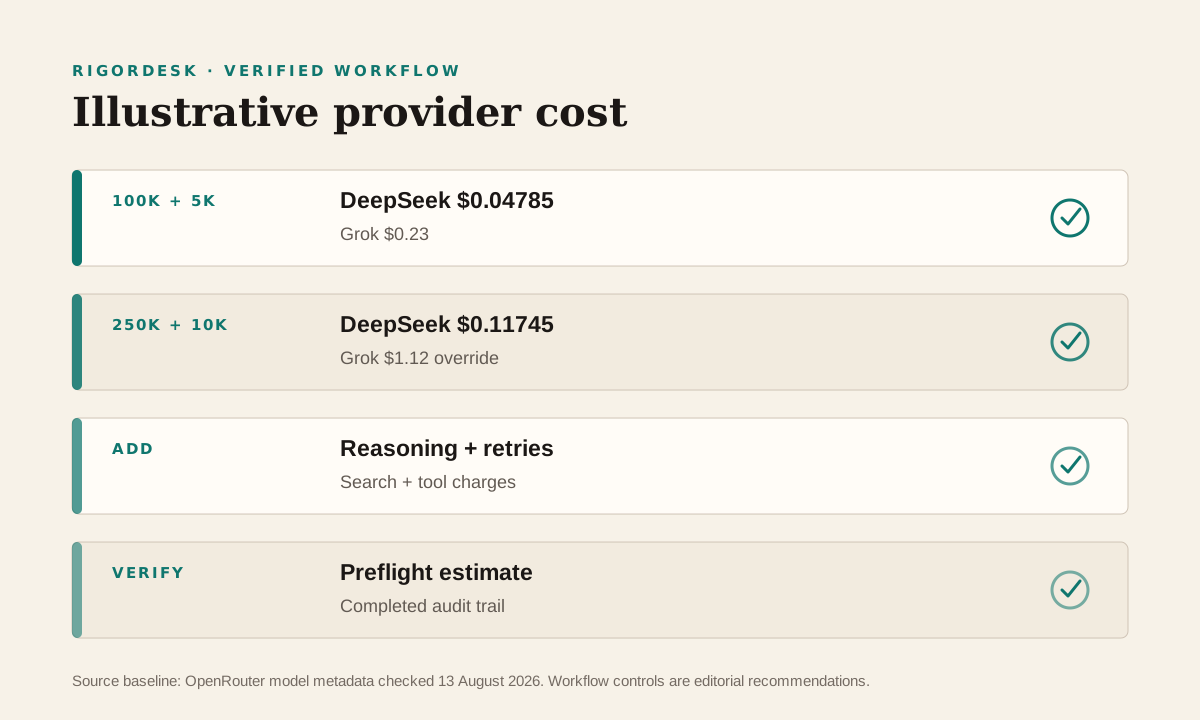
At standard list rates, a call with 100,000 input tokens and 5,000 output tokens costs about $0.04785 on DeepSeek V4 Pro 0813: $0.0435 for input plus $0.00435 for output. The same token counts cost about $0.23 on Grok 4.6: $0.20 for input plus $0.03 for output. These examples exclude web-search charges, caching effects, platform metering, and any extra reasoning or retry tokens reported by the provider.
For a 250,000-token prompt and 10,000 output tokens, Grok crosses its published 200K prompt threshold. Applying the override produces roughly $1.12: $1.00 of input and $0.12 of output. DeepSeek at its base rates would be about $0.11745 for the same token counts. The comparison is mathematically useful but incomplete if the source includes images or files that DeepSeek cannot inspect natively.
Budget the panel rather than one call
A RigorDesk run contains multiple model turns, possible consensus evaluation, and a chairman synthesis. Later rounds may include prior transcript context, so input grows even when the user's original prompt does not. Web search adds provider charges and retrieved text. Thinking can increase billed output. The editor's preflight estimate is therefore a planning range; the audit trail is the authoritative record for the completed run.
Cost control starts with role design. Do not send a 400K-token evidence packet to four models if two seats only need a retrieved subset. Use a cheaper long-context reader to extract contested claims, then give the critic the claims plus relevant evidence. Cap rounds, define stop conditions, and reserve Grok's native multimodal seat for artifacts where it changes what the panel can observe.
Use a complete cost equation
The minimum useful estimate separates prompt tokens, completion tokens, cached input, search calls, and repeated rounds. For each seat, multiply metered units by the provider rate that applies to that request, then add retries and tool charges. Grok lists a web-search price and an input-cache rate in addition to token prices. DeepSeek lists a much lower cache-read price. Whether caching helps depends on provider routing and request structure, so a planning sheet should not assume a cache hit until production usage reports confirm one.
Reasoning complicates the equation because billed completion can include more than the visible answer. A strict output limit controls only part of the behavior if the provider reports separate reasoning usage. Multi-round debate compounds prompt size as prior claims, evidence, and objections return to later seats. The accurate unit is therefore a completed review, not an isolated first call. RigorDesk's audit trail should be used to reconcile the estimate against actual usage and identify which seat or round caused a variance.
Model three budget scenarios
Create a low case for ordinary inputs with one response per seat, a likely case using the median prompt and output lengths from recent runs, and a high case containing another round, a retry, and the largest eligible evidence packet. Apply Grok's override to any request whose prompt crosses 200,000 tokens rather than averaging the base and override rates. For DeepSeek, include the possibility that a million-token corpus increases latency and produces a larger synthesis even though the per-token rate remains low.
The scenario table should also include human preparation and repair. OCR cleanup, file conversion, schema correction, and manual citation checks have real labor costs. Grok may cost more per token but save extraction work when it can inspect the original artifact. DeepSeek may enable an additional challenger round for less provider spend and find an objection that avoids later rework. Total economic value depends on which workflow reduces expensive mistakes, not which line item has the smallest number.
Set guardrails that preserve review quality
Cost control should remove redundant work before it removes independent scrutiny. Retrieve relevant passages instead of sending every appendix to every seat. Give the artifact reviewer only the pages containing visual evidence. Ask the analyst to extract disputed claims once and reuse the structured result. Cap rounds when no new evidence or objection appears. Use cheaper seats for broad extraction and reserve expensive models for tasks where their input modality or demonstrated accuracy changes the decision.
Avoid a single hard token cap that causes silent truncation. Define what happens when the budget is insufficient: narrow the evidence with traceable retrieval, ask the user to prioritize documents, reduce panel size explicitly, or stop with an incomplete status. A review that quietly drops the end of a contract is cheap only on the invoice. Good budget controls keep omissions visible and preserve the operator's ability to decide whether additional scrutiny is worth purchasing.
Decision table
| Budget component | Planning treatment | Verification source |
|---|---|---|
| Input and output tokens | Apply the rate for each request | Provider usage record |
| Grok prompts above 200K | Use the published override | Prompt-token count |
| Search, tools, and retries | Model separately from base inference | Tool and retry audit events |
| Human preparation and repair | Estimate time by workflow | Observed operating process |
Visual summary
Verified specification baseline
| Field | DeepSeek V4 Pro 0813 | Grok 4.6 |
|---|---|---|
| OpenRouter model ID | deepseek/deepseek-v4-pro-0813 | x-ai/grok-4.6 |
| Release status | GA release of DeepSeek V4 Pro | Current SpaceXAI frontier listing |
| Context window | 1,048,576 tokens | 500,000 tokens |
| Input modalities | Text | Text, image, file |
| Output modality | Text | Text |
| Standard input price | $0.435 per million tokens | $2 per million tokens |
| Standard output price | $0.87 per million tokens | $6 per million tokens |
| Long-prompt override | None listed | Above 200,000 prompt tokens: $4/M input and $12/M output |
| Reasoning controls | Supported | Supported |
| Tool calling | Supported | Supported |
The table is a capability and cost baseline, not a quality ranking. A larger context window does not prove better retrieval from the middle of a long prompt. A lower token price does not prove lower total task cost because output length, retries, reasoning tokens, and tool calls all affect the bill. A multimodal input declaration confirms accepted media types, not accuracy on every chart, screenshot, scan, or document.
Neither listing supplied a new, independently replicated benchmark suite at publication time. That absence matters. It is reasonable to describe Grok 4.6 as intended for coding, knowledge work, and STEM because the provider says so; it is not reasonable to turn that sentence into an unqualified claim that Grok wins a particular coding or science benchmark. The same rule applies to the DeepSeek GA label: general availability describes release maturity, not guaranteed superiority over the earlier model on every workload.
How to evaluate the models on RigorDesk
Start with a controlled case set drawn from real work. Keep the source packet, prompt, output contract, reasoning setting, web-search setting, and maximum output length fixed. Randomize seat order or use a silent Delphi first round so the first model does not anchor the rest. Record model IDs rather than family names because deepseek/deepseek-v4-pro and deepseek/deepseek-v4-pro-0813 are different runtime contracts.
Score outcomes that users can inspect: factual claims supported by the attached evidence, important objections found, invalid objections avoided, instructions followed, useful citations produced, schema validity, completion latency, and metered cost. For coding work, add tests passed and regressions introduced. For document review, add page-level evidence recall and whether the model distinguishes missing evidence from negative evidence. For a debate, preserve dissent instead of rewarding superficial agreement.
Run enough cases to expose variance. A single polished response is a demonstration, not an evaluation. Compare medians and failure distributions, then read the worst failures. Expensive mistakes are often concentrated in a small class of prompts: very long inputs, malformed files, ambiguous requirements, or tasks that require several tools. Those tail cases should influence the final seat assignment more than a small difference in average style scores.
Deployment checklist
- Apply Grok's override whenever prompt tokens exceed 200,000.
- Estimate growing transcript context across debate rounds.
- Separate provider list rates from purchased compute-credit accounting.
- Use the completed audit trail for reconciliation.
On RigorDesk, both models are in the paid catalog and can be selected in assemblies, debates, Draft, and Review. Paid plans share access to the complete model catalog; Pro Max changes compute allowance and round depth. Prepaid credits also unlock paid models in the web app. The editor estimates a run before launch, while the audit trail records actual token use and provider cost after completion.
Model availability is only one layer of a reliable workflow. Keep evidence attached, define role boundaries, require explicit uncertainty, and assign a separate chairman or synthesizer when the decision is consequential. The goal is not to prove that one vendor always wins. The goal is to discover which model contributes the most independent, verifiable value for a specific class of decisions.