
DeepSeek V4 Pro 0813 and Grok 4.6 are live on RigorDesk
August 13, 2026 · By Sharjeel Abbas
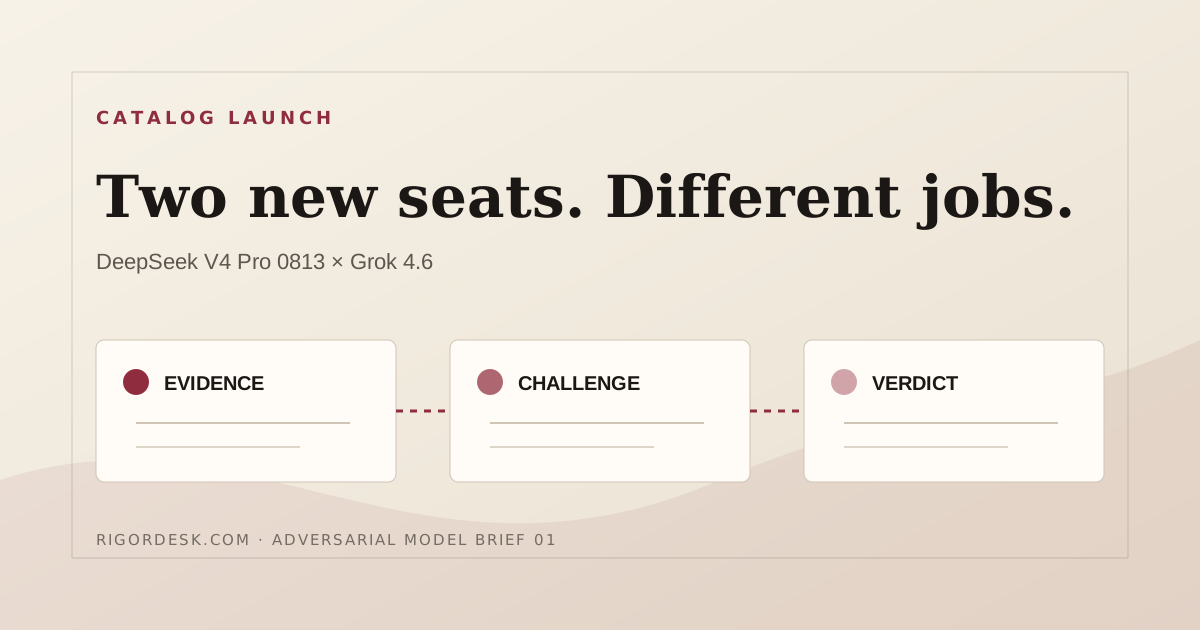
Two August 12 releases are now selectable across RigorDesk. DeepSeek V4 Pro 0813 brings a one-million-token text workflow at unusually low list prices. Grok 4.6 brings image and file input, a 500K context window, and a frontier profile aimed at coding, knowledge work, and STEM. They belong in different seats rather than being treated as interchangeable upgrades.
The primary catalog sources for this analysis are OpenRouter's DeepSeek V4 Pro 0813 listing and OpenRouter's Grok 4.6 listing. Specifications and prices below were checked against OpenRouter's models API on August 13, 2026. Provider metadata can change, so production buyers should recheck the live listing before committing a fixed budget.
Related reading:
What changed in the catalog
The DeepSeek addition is not a cosmetic rename. The existing catalog already contained deepseek/deepseek-v4-pro. The August GA release uses deepseek/deepseek-v4-pro-0813, so RigorDesk preserves both IDs. Existing assemblies remain reproducible, while new assemblies can choose the dated GA contract explicitly. This is important for audit trails, retries, and any comparison that claims to measure an upgrade.
Grok 4.6 is added beside Grok 4.5, Grok 4.20, and Grok 4.3. It does not replace historical model IDs inside saved sessions. New work can select x-ai/grok-4.6; old transcripts continue to show the model that actually generated them. That separation prevents an evergreen label from silently changing the system under evaluation.
Where each model fits
DeepSeek V4 Pro 0813 is the obvious candidate for text-heavy evidence review, long transcripts, large repositories converted to text, and cost-sensitive panels that still need a reasoning-capable model. Its listed input price is less than one quarter of Grok's standard input price, and its output price is less than one sixth of Grok's. That gap makes DeepSeek attractive for repeated rounds, but output quality still has to be measured on the actual task.
Grok 4.6 is the broader-input candidate. Image and file support matter when the evidence includes screenshots, diagrams, charts, or documents that should not be flattened before review. It also makes sense as an adversarial or critic seat when a panel already includes DeepSeek, Claude, or GPT. Provider diversity is useful because different training and product decisions can surface different assumptions, though diversity never guarantees independence or truth.
What the launch does not prove
A catalog launch proves that the model IDs can be selected and that their declared capabilities can be routed through the product. It does not prove that either model is best for a workload. OpenRouter reproduces the provider description that Grok 4.6 has frontier performance on coding, knowledge work, and STEM, but that sentence is a provider claim rather than an independently replicated result. DeepSeek's GA designation describes release status, not a universal quality guarantee. Teams should treat both entries as candidates whose value must be demonstrated on their own evidence, prompts, tools, and acceptance criteria.
The distinction matters because model launches concentrate attention on average quality while production failures live in the tails. A model can produce excellent prose and still miss a clause in the middle of a long file, misread a chart legend, emit invalid structured data, or call a tool with unsafe arguments. RigorDesk exposes the panel and audit trail needed to observe those failures, but the operator still owns the evaluation design. A polished launch article should therefore establish a testable baseline, not declare a winner before representative cases have run.
A safe first-week rollout
Start with shadow assemblies that copy a real production configuration while changing only one model seat. Preserve the original model, parameters, prompt, documents, debate format, and output contract. Run a small but varied case set containing ordinary inputs, long inputs, ambiguous evidence, malformed files, tool failures, and at least one case where the correct outcome is to remain uncertain. Compare the new transcript with the established baseline and review every material disagreement. This paired design reveals what changed without confusing the model upgrade with a prompt or workflow redesign.
Move from shadow runs to canaries only after defining promotion and rollback thresholds. Useful thresholds include supported-claim rate, critical omission count, invalid schema rate, tool-call error rate, median and tail latency, output-token growth, and total provider cost. A canary can route a small share of eligible work to the new assembly while retaining the prior configuration for immediate rollback. Keep versioned IDs in every saved assembly and exported report so a later provider update cannot rewrite the history of what was tested.
How users should choose the first seat
Choose DeepSeek first when the decisive evidence is already reliable text, the corpus is unusually large, or the panel needs several economical rounds. Its 1,048,576-token context window provides more nominal headroom than Grok's 500,000 tokens, and its listed base prices make repeated text analysis cheaper. Choose Grok first when screenshots, diagrams, charts, or original files contain information that would be damaged by flattening. Native multimodal input can remove an extraction step, although every visual conclusion still needs a page, region, or artifact reference that a human can inspect.
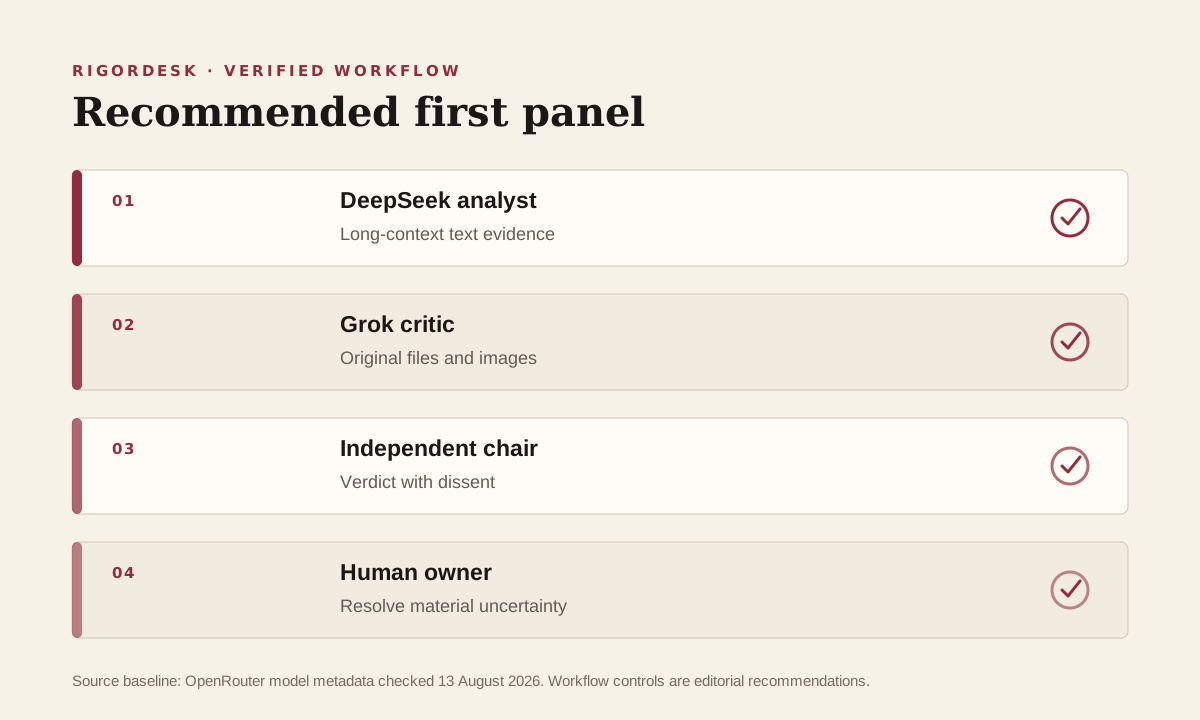
Use both when the decision justifies an explicit perception-versus-reasoning check. Let Grok inspect the original artifact and let DeepSeek inspect a traceable text extraction. Ask both to classify claims as supported, contradicted, or unresolved, then focus the next round only on disagreements. The chairman should preserve unresolved conflicts rather than averaging them away. This design turns different input capabilities into observable review value and gives the operator a precise place to intervene when the models disagree about what the evidence contains.
Decision table
| Launch decision | Recommended action | Evidence to retain |
|---|---|---|
| Text-heavy corpus | Canary DeepSeek in the analyst seat | Retrieval probes and cited passages |
| Images or mixed files | Canary Grok in the artifact-review seat | Page and region references |
| High-stakes decision | Use both plus an independent chairman | Dissent map and final audit trail |
| Existing saved workflow | Keep the previous versioned model ID | Paired baseline and rollback criteria |
Visual summary
Verified specification baseline
| Field | DeepSeek V4 Pro 0813 | Grok 4.6 |
|---|---|---|
| OpenRouter model ID | deepseek/deepseek-v4-pro-0813 | x-ai/grok-4.6 |
| Release status | GA release of DeepSeek V4 Pro | Current SpaceXAI frontier listing |
| Context window | 1,048,576 tokens | 500,000 tokens |
| Input modalities | Text | Text, image, file |
| Output modality | Text | Text |
| Standard input price | $0.435 per million tokens | $2 per million tokens |
| Standard output price | $0.87 per million tokens | $6 per million tokens |
| Long-prompt override | None listed | Above 200,000 prompt tokens: $4/M input and $12/M output |
| Reasoning controls | Supported | Supported |
| Tool calling | Supported | Supported |
The table is a capability and cost baseline, not a quality ranking. A larger context window does not prove better retrieval from the middle of a long prompt. A lower token price does not prove lower total task cost because output length, retries, reasoning tokens, and tool calls all affect the bill. A multimodal input declaration confirms accepted media types, not accuracy on every chart, screenshot, scan, or document.
Neither listing supplied a new, independently replicated benchmark suite at publication time. That absence matters. It is reasonable to describe Grok 4.6 as intended for coding, knowledge work, and STEM because the provider says so; it is not reasonable to turn that sentence into an unqualified claim that Grok wins a particular coding or science benchmark. The same rule applies to the DeepSeek GA label: general availability describes release maturity, not guaranteed superiority over the earlier model on every workload.
How to evaluate the models on RigorDesk
Start with a controlled case set drawn from real work. Keep the source packet, prompt, output contract, reasoning setting, web-search setting, and maximum output length fixed. Randomize seat order or use a silent Delphi first round so the first model does not anchor the rest. Record model IDs rather than family names because deepseek/deepseek-v4-pro and deepseek/deepseek-v4-pro-0813 are different runtime contracts.
Score outcomes that users can inspect: factual claims supported by the attached evidence, important objections found, invalid objections avoided, instructions followed, useful citations produced, schema validity, completion latency, and metered cost. For coding work, add tests passed and regressions introduced. For document review, add page-level evidence recall and whether the model distinguishes missing evidence from negative evidence. For a debate, preserve dissent instead of rewarding superficial agreement.
Run enough cases to expose variance. A single polished response is a demonstration, not an evaluation. Compare medians and failure distributions, then read the worst failures. Expensive mistakes are often concentrated in a small class of prompts: very long inputs, malformed files, ambiguous requirements, or tasks that require several tools. Those tail cases should influence the final seat assignment more than a small difference in average style scores.
Deployment checklist
- Use the dated DeepSeek ID when evaluating the GA release.
- Use Grok 4.6 when native image or file evidence is material to the case.
- Keep an independent chairman when both models are participants.
- Review the final audit trail for actual cost and unresolved dissent.
On RigorDesk, both models are in the paid catalog and can be selected in assemblies, debates, Draft, and Review. Paid plans share access to the complete model catalog; Pro Max changes compute allowance and round depth. Prepaid credits also unlock paid models in the web app. The editor estimates a run before launch, while the audit trail records actual token use and provider cost after completion.
Model availability is only one layer of a reliable workflow. Keep evidence attached, define role boundaries, require explicit uncertainty, and assign a separate chairman or synthesizer when the decision is consequential. The goal is not to prove that one vendor always wins. The goal is to discover which model contributes the most independent, verifiable value for a specific class of decisions.