
Reasoning, tools, and structured outputs with DeepSeek and Grok
August 13, 2026 · By Sharjeel Abbas
Both models expose the controls needed for serious agent workflows, but capability flags are only the start. Reliable systems bound reasoning, validate tool arguments and outputs, distinguish tool failure from model failure, and treat structured generation as untrusted input.
The primary catalog sources for this analysis are OpenRouter's DeepSeek V4 Pro 0813 listing and OpenRouter's Grok 4.6 listing. Specifications and prices below were checked against OpenRouter's models API on August 13, 2026. Provider metadata can change, so production buyers should recheck the live listing before committing a fixed budget.
Related reading:
Reasoning is a budgeted capability
DeepSeek V4 Pro 0813 and Grok 4.6 both list reasoning and reasoning-effort parameters. Enable them for difficult analysis, planning, and contradiction resolution; disable or reduce them for simple transformations. More reasoning can increase latency and billed tokens without improving an easy task. Evaluate low, medium, and high effort on a fixed case set instead of defaulting every request to maximum effort.
Applications should store the requested setting and usage totals but avoid depending on hidden reasoning text as a business record. The durable artifact is the final claim with evidence, tool results, and uncertainty. If a model reaches a correct conclusion through unsupported private reasoning, a reviewer still cannot verify it. Require concise rationale that cites observable sources.
Tools and schemas need hard boundaries
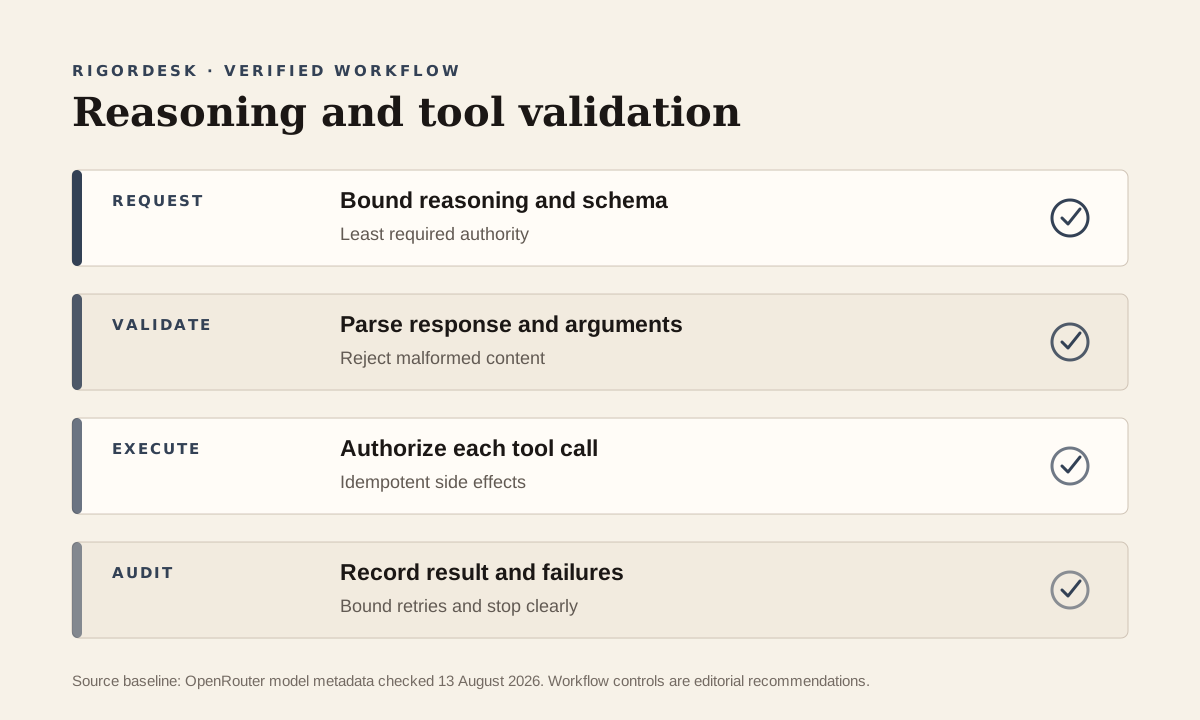
Both models support tool choice and tool calls. Validate arguments against a schema before execution, authorize each tool independently, cap calls, and return explicit errors. A model should never gain broader permissions because it selected a plausible function name. Idempotency matters for tools that create or modify external state, and read-only tools should be preferred during debate and review.
Response formats are supported by both listings, while Grok explicitly lists structured outputs. Parse defensively. Reject missing required fields, unexpected enums, oversized strings, and trailing prose when a strict contract is required. Preserve the raw response for diagnosis, then retry with a bounded policy or fail clearly. Do not wrap every call in silent recovery that converts malformed output into fabricated defaults.
Specify a bounded response contract
Define required fields, allowed enums, maximum lengths, citation shapes, and whether additional properties are forbidden. Distinguish a missing field from an explicit unknown value. Include a status that can represent incomplete evidence rather than forcing the model to invent a result. Validate the complete response before downstream use and preserve the raw provider output for diagnosis. A parser that silently drops unexpected fields can conceal prompt injection, schema drift, or a model attempt to explain why it could not comply.
Use structured outputs for machine boundaries and human-readable prose for the final artifact. The structured record can hold claims, evidence IDs, tool requests, uncertainty, and errors; a separate rendering layer can turn validated data into a report. This separation prevents formatting preferences from weakening the contract. Although Grok explicitly lists structured outputs and both models list response formats, neither capability flag eliminates truncation, refusals, provider errors, or malformed content. Validation remains mandatory.
Treat every tool call as an authorization request
Match the requested tool against an allowlist for the current user, workspace, and debate role. Validate arguments, normalize identifiers, enforce resource limits, and show the model only the tools required for the task. Read-only tools should be the default during analysis. Side-effecting tools require idempotency keys, explicit scope, and a clear approval policy. A plausible function name or well-formed JSON does not grant authority to send a message, modify a database, spend money, or deploy code.
Return tool results in a structured envelope that distinguishes success, empty result, timeout, authorization denial, invalid arguments, and upstream failure. The model should not infer that an empty response proves a negative fact. Cap retries and total calls, and prevent a failed tool from causing an unbounded reasoning loop. Record the request, validated arguments, authorization decision, result status, and model response. This audit path makes operational mistakes debuggable and lets reviewers separate model reasoning failure from unavailable infrastructure.
Evaluate reasoning settings empirically
Create task cohorts for extraction, classification, contradiction analysis, planning, and difficult synthesis. Run supported reasoning-effort settings with fixed evidence and output contracts. Compare task success, unsupported claims, completion tokens, latency, and total cost. More reasoning is justified only when the measured gain matters for that cohort. A global maximum setting wastes resources on simple transformations and can make interactive review slower without improving the final artifact.
Store the requested setting and provider usage, but base the audit record on observable evidence and concise rationale rather than hidden reasoning text. Ask the model to name the sources, tool results, assumptions, and uncertainty behind its final claim. Red-team the system with malformed tool results, prompt-like instructions inside files, partial schemas, truncation, and conflicting sources. A reliable workflow fails closed at authority boundaries and fails visibly when the evidence or contract cannot support a valid answer.
Decision table
| Boundary | Required validation | Failure behavior |
|---|---|---|
| Structured response | Schema, size, enums, and required fields | Reject or bounded retry |
| Tool request | Identity, authority, arguments, and limits | Deny without side effect |
| Tool result | Status envelope and output schema | Expose error to the model and audit |
| Reasoning configuration | Measured gain by task cohort | Use lower effort or stop |
Visual summary
Verified specification baseline
| Field | DeepSeek V4 Pro 0813 | Grok 4.6 |
|---|---|---|
| OpenRouter model ID | deepseek/deepseek-v4-pro-0813 | x-ai/grok-4.6 |
| Release status | GA release of DeepSeek V4 Pro | Current SpaceXAI frontier listing |
| Context window | 1,048,576 tokens | 500,000 tokens |
| Input modalities | Text | Text, image, file |
| Output modality | Text | Text |
| Standard input price | $0.435 per million tokens | $2 per million tokens |
| Standard output price | $0.87 per million tokens | $6 per million tokens |
| Long-prompt override | None listed | Above 200,000 prompt tokens: $4/M input and $12/M output |
| Reasoning controls | Supported | Supported |
| Tool calling | Supported | Supported |
The table is a capability and cost baseline, not a quality ranking. A larger context window does not prove better retrieval from the middle of a long prompt. A lower token price does not prove lower total task cost because output length, retries, reasoning tokens, and tool calls all affect the bill. A multimodal input declaration confirms accepted media types, not accuracy on every chart, screenshot, scan, or document.
Neither listing supplied a new, independently replicated benchmark suite at publication time. That absence matters. It is reasonable to describe Grok 4.6 as intended for coding, knowledge work, and STEM because the provider says so; it is not reasonable to turn that sentence into an unqualified claim that Grok wins a particular coding or science benchmark. The same rule applies to the DeepSeek GA label: general availability describes release maturity, not guaranteed superiority over the earlier model on every workload.
How to evaluate the models on RigorDesk
Start with a controlled case set drawn from real work. Keep the source packet, prompt, output contract, reasoning setting, web-search setting, and maximum output length fixed. Randomize seat order or use a silent Delphi first round so the first model does not anchor the rest. Record model IDs rather than family names because deepseek/deepseek-v4-pro and deepseek/deepseek-v4-pro-0813 are different runtime contracts.
Score outcomes that users can inspect: factual claims supported by the attached evidence, important objections found, invalid objections avoided, instructions followed, useful citations produced, schema validity, completion latency, and metered cost. For coding work, add tests passed and regressions introduced. For document review, add page-level evidence recall and whether the model distinguishes missing evidence from negative evidence. For a debate, preserve dissent instead of rewarding superficial agreement.
Run enough cases to expose variance. A single polished response is a demonstration, not an evaluation. Compare medians and failure distributions, then read the worst failures. Expensive mistakes are often concentrated in a small class of prompts: very long inputs, malformed files, ambiguous requirements, or tasks that require several tools. Those tail cases should influence the final seat assignment more than a small difference in average style scores.
Deployment checklist
- Select reasoning effort by task difficulty and measured gain.
- Validate tool arguments before execution and tool results after return.
- Use idempotency for side-effecting calls.
- Treat every structured response as untrusted until schema validation passes.
On RigorDesk, both models are in the paid catalog and can be selected in assemblies, debates, Draft, and Review. Paid plans share access to the complete model catalog; Pro Max changes compute allowance and round depth. Prepaid credits also unlock paid models in the web app. The editor estimates a run before launch, while the audit trail records actual token use and provider cost after completion.
Model availability is only one layer of a reliable workflow. Keep evidence attached, define role boundaries, require explicit uncertainty, and assign a separate chairman or synthesizer when the decision is consequential. The goal is not to prove that one vendor always wins. The goal is to discover which model contributes the most independent, verifiable value for a specific class of decisions.